/CGLUX (Definitivo)-13.png)
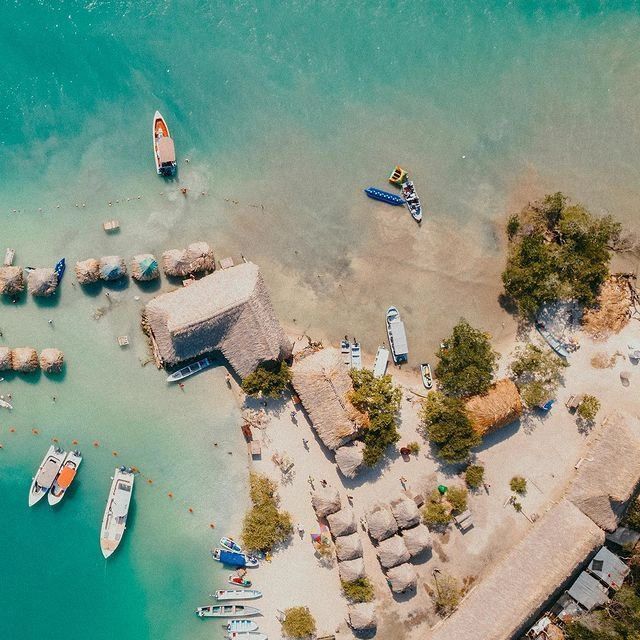
The Islas del Rosario — a coral archipelago 35 kilometers southwest of Cartagena — are among the most beautiful waters in the Caribbean. Thirty-some islands, most uninhabited, surrounded by water that shifts from turquoise to deep cobalt depending on the depth and the angle of the sun. Coral formations that have been growing for centuries. Silence, interrupted only by the sound of water against a hull.
Most visitors to Cartagena know the Rosario Islands exist. Far fewer experience them in a way that reflects what they actually are. The difference lies almost entirely in how you get there.
Ferry vs. Private Charter — What Most Visitors Do Wrong
The standard approach to the Rosario Islands from Cartagena is the public ferry, which departs from the Muelle Turistico in the mornings and delivers groups of 30–50 passengers to one of two or three island stops. The journey takes 45–90 minutes depending on the vessel and sea conditions. Passengers share a beach with whoever else arrived on that boat and the half-dozen other boats that follow throughout the morning. Lunch comes from a set menu. The return leaves at a fixed time regardless of what anyone would prefer.
This experience is not without its merits — the water is genuinely beautiful, the islands are stunning, and the ferry is accessible and affordable. But it is a fundamentally shared experience in a place that reveals itself most completely in private.
"The Rosario Islands reveal themselves most completely in silence — and silence requires arriving on your own vessel, on your own schedule."
A private yacht charter from Cartagena operates on an entirely different logic. You board when you choose, travel with your own party, anchor where the captain recommends rather than where the crowd has already gathered, and return when you decide the day is complete. The islands you reach on a private charter are not the ones the ferry stops at. They are the ones beyond — the unnamed sandbars, the uninhabited stretches, the anchorages where you might be the only boat for hours.
Quick Facts
What to Expect on the Islands
The Rosario archipelago is a national park — the Parque Nacional Natural Corales del Rosario y San Bernardo — which limits development and protects the coral ecosystem. Most of the islands are small enough to walk around in fifteen minutes. The largest, Isla Grande, has a small inland lagoon, some modest accommodation, and the only permanent population in the archipelago.
The water is the primary attraction. The Caribbean here is exceptionally clear — visibility of 15–20 meters is common in the dry season — and the coral formations, though affected by decades of warming and earlier degradation, contain an extraordinary variety of marine life. Snorkeling in the shallower areas around the smaller islands is among the finest in the southern Caribbean.
There are no luxury hotels in the traditional sense on the Rosario Islands. The island experience is, by design, about the water, the light, the simplicity of a place that has remained largely untouched. Lunch is typically prepared aboard the charter vessel or at one of the small restaurants on Isla Grande — fresh fish, coconut rice, the particular flavor of something eaten at anchor in 30°C sunshine.
The Best Anchorages and Swimming Spots
The islands most experienced guides favor for a private charter are not the ones closest to Cartagena. The best spots require knowing where to look:
- The sandbar between Isla Múcura and Isla Tintipán — accessible only by small vessel at high tide, with water of extraordinary clarity and complete privacy
- The eastern edge of Isla Grande — where the lagoon meets open water and the reef is intact enough to make snorkeling genuinely worthwhile
- The unnamed sandbars northwest of the main cluster — barely above water at high tide, often completely deserted, with the particular beauty of an island that exists only for a few hours each day
- The outer reef drop-offs — for guests with diving experience, the reef walls beyond the main island cluster descend dramatically and support the richest marine life in the archipelago
A Full Day Private Itinerary
A well-planned full-day charter from Cartagena typically follows this arc:
7:30am — Departure from a private marina in Bocagrande or the old town. The early start places you at the islands before the ferry traffic arrives. The Caribbean in the early morning — flat water, low light, the city fading behind you — is worth the early alarm.
9:00am — First anchorage at one of the quieter outer islands. Swimming, snorkeling, or simply sitting on deck with the water to yourself. The captain and crew handle everything.
12:30pm — Lunch served aboard or at a pre-arranged restaurant on Isla Grande. Fresh catch, cold drinks, no particular rush.
2:30pm — Afternoon anchorage at a second location, typically a sandbar or the lagoon. The afternoon light on the water is different from the morning — warmer, lower, more photogenic.
5:00pm — Return to Cartagena. The sunset from the water, looking back at the city's colonial skyline, is one of the best vantages the destination offers.
What to Bring
- Reef-safe sunscreen — standard sunscreen is prohibited in the national park
- Snorkeling equipment (or request it from your charter operator)
- A light layer for the return journey — the wind picks up in the late afternoon
- Cash in Colombian pesos for any island purchases
- A waterproof bag for phones and cameras
The best time for a Rosario Islands charter is January through March, when the sea is calmest and visibility is at its highest. June and July are also excellent. October and November are the most likely to require weather flexibility.
What the Rosario Islands offer — at their best, on a private vessel, with the day entirely your own — is the particular luxury of space. Space on the water, space in the schedule, space to let the Caribbean do what it does when no one is rushing through it. It is an experience that is difficult to replicate elsewhere and very easy to understand once you've had it.
/CGLUX (Definitivo)-12.png)