/CGLUX (Definitivo)-13.png)
To understand Cartagena's history is to understand how the modern world was built. This city on Colombia's Caribbean coast was one of the most strategically important ports in the Spanish Empire — the gateway through which the gold and silver of South America passed on its way to Europe, and through which thousands of enslaved Africans entered the New World. Its walls, its churches, its fortresses, and its streets carry the entire weight of that history, and walking them with knowledge is a fundamentally different experience from walking them without it.
This is also a city that has not finished becoming what it is. Cartagena's culture is not a museum piece — it is a living inheritance, contested and renewed by each generation, shaped by the African roots that the colonial record tried to suppress and that have instead become the city's most distinctive cultural gift to the world.
Founded in 1533 — Spain's Gateway to South America
Cartagena de Indias was founded on June 1, 1533 by the Spanish conquistador Pedro de Heredia. The settlement was established on the site of an indigenous village, and its natural harbor — one of the finest on the Caribbean coast — made it immediately valuable to the Spanish colonial enterprise.
Within decades, Cartagena had become the primary point of departure for the gold and silver extracted from the mines of Peru and Bolivia. The city grew quickly: churches, convents, merchant houses, and the administrative apparatus of empire were established in the colonial grid that still defines the walled city today. By the late 16th century, Cartagena was one of the wealthiest cities in the Americas — which also made it one of the most frequently attacked.
"Cartagena was built to hold a continent's wealth. The walls that surround it today were built because the world knew exactly what was kept here."
The Slave Trade and the African Heritage That Defines the City
Between 1533 and the abolition of the slave trade in the early 19th century, Cartagena was one of the principal entry points for enslaved Africans brought to the Americas. Estimates suggest that more than a million people passed through the city's port in chains during this period. The human consequences of that history — the suffering, the resistance, the survival — are woven into every aspect of what Cartagena is today.
What emerged from this history was not erasure but transformation. The African cultural inheritance in Cartagena is visible in its music — cumbia, champeta, and vallenato all carry African rhythmic structures — in its food, in its spiritual traditions, and in the vitality of communities like Palenque de San Basilio, 50 kilometers from the city.
San Basilio de Palenque holds a singular place in the history of the Americas: it was the first free African community in the New World, founded by enslaved people who escaped the colonial system and established an autonomous settlement that Spanish authorities were ultimately unable to suppress. In 2005, UNESCO recognized Palenque's cultural space as an Intangible Cultural Heritage of Humanity — one of only a handful of such designations in the Americas. The Palenqueras — women from this community who sell fruit in the walled city in traditional dress — are not a tourist attraction. They are a living connection to this history.
The Walls That Defended a Continent
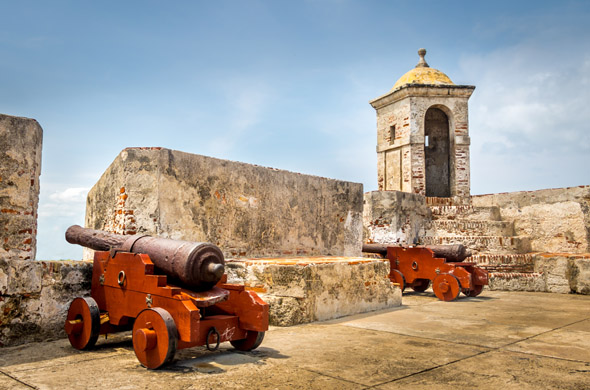
The fortification of Cartagena began in earnest after Sir Francis Drake sacked the city in 1586, extracting a ransom of 107,000 ducats and burning much of what he found. The Spanish response was the most ambitious military engineering project in the Americas: a ring of walls, bastions, and fortresses that would eventually enclose the entire colonial city and extend to control the bay's approaches.
Construction continued for more than two centuries. The result — the walls that stand today — is one of the largest and best-preserved military fortification systems in the Americas, and the primary reason for Cartagena's UNESCO World Heritage designation in 1984. The walls are between 9 and 12 meters high and up to 17 meters wide in some sections; walking their perimeter at sunset is among the finest urban experiences in Latin America.
The Castillo de San Felipe de Barajas, the great fortress that commands the hill above the city, represents the apex of this defensive system. Its tunnel network, designed to allow rapid troop movement while confusing attackers, extends for hundreds of meters beneath the structure. It successfully repelled the British assault of 1741 — one of the largest naval expeditions in history — when Blas de Lezo's vastly outnumbered Spanish garrison held the city against an attacking force of 23,000 men.
A Timeline of Cartagena's History
Foundation. Pedro de Heredia establishes Cartagena de Indias on the site of an indigenous settlement. The natural harbor immediately becomes Spain's primary Caribbean port.
Drake's Sack. Sir Francis Drake raids the city with 23 ships and 2,300 men. The Spanish ransom payment of 107,000 ducats triggers a century of defensive construction.
The Inquisition. The Palace of the Inquisition is established in Cartagena — the only tribunal of the Spanish Inquisition in South America. Its archives document the collision of three cultures across two centuries.
San Basilio de Palenque. The free African community, established by escaped enslaved people, achieves a degree of recognition from colonial authorities — the first such community in the Americas.
The Battle of Cartagena. Blas de Lezo holds the city against a British force of 186 ships and 23,000 men. The defeat of the British — rarely taught in English-language history — was one of the most decisive battles of the 18th-century Caribbean.
Independence. Cartagena declares independence from Spain on November 11 — the first city in Colombia to do so. November 11 remains the city's most important annual celebration.
UNESCO designation. The historic center and fortifications of Cartagena are inscribed as a UNESCO World Heritage Site — one of the first in Colombia.
García Márquez. Gabriel García Márquez, who grew up on Colombia's Caribbean coast and set his greatest novels in Cartagena and the surrounding region, wins the Nobel Prize for Literature.
Independence and the 19th Century
On November 11, 1811, Cartagena became the first city in Colombia to declare independence from Spain. The date is still the city's most important annual celebration — the Fiestas de Independencia transform the old town each November with parades, music, and the particular joy of a city remembering its own defiance.
The independence period was followed by decades of relative economic decline as the city lost its privileged position as a colonial trading hub. The 19th century was quieter, and in some ways more intimate — the city contracted into itself, and much of the colonial architecture that might otherwise have been demolished or developed was simply left in place, waiting.
The 20th Century — Literature, Rediscovery, and Tourism
The great event of Cartagena's 20th century was Gabriel García Márquez. The Nobel laureate, who spent significant periods of his life in the city and set Love in the Time of Cholera and much of The General in His Labyrinth in its streets, gave Cartagena a global literary identity that no marketing campaign could have achieved. The city became, through his writing, a place of mythological density — where love and history and the tropics collided in ways that were specific and universal at once.
Tourism arrived seriously in the 1970s and accelerated through the 1990s and 2000s as Colombia's security situation improved. The historic center was increasingly restored rather than replaced. International hotel groups arrived. The boutique hotel movement — the conversion of colonial mansions into intimate luxury properties — began in earnest in the 2000s and transformed the old town's accommodation landscape.
Cartagena Today — Culture as a Living Thing
The Cartagena of today is a city managing the tension between its extraordinary inheritance and its contemporary ambitions. The old town has become one of Latin America's most desirable addresses — for luxury hotels, for restaurants, for short-term villa rentals — while communities like Getsemaní, just outside the walls, navigate the pressures of rapid gentrification with a creativity that has made the neighborhood one of the most culturally alive in the country.
The cultural calendar reflects this complexity: the Hay Festival in January, one of the most prestigious literary events in the Spanish-speaking world; the International Film Festival in March; the Fiestas de Independencia in November; and a year-round rhythm of music, art, and gastronomy that operates independently of the tourist cycle.
What distinguishes Cartagena from other great heritage cities is the degree to which its culture is not curated for visitors but lived by residents. The Palenqueras walk the same streets they have always walked. The cumbia plays in the plazas because it has always played there. The city's complexity — its inequalities as well as its elegance, its African roots as well as its Spanish facades — is visible everywhere to those who look for it. That visibility is what makes Cartagena's culture genuinely compelling, and what makes the city genuinely irreplaceable.
/CGLUX (Definitivo)-12.png)